Lookalike Audiences: Use Client Data to Improve ROAS
Learn how lookalike audiences use client data to find qualified prospects, improve audience targeting, and increase return on ad spend. Learn practical
What Are Lookalike Audiences?
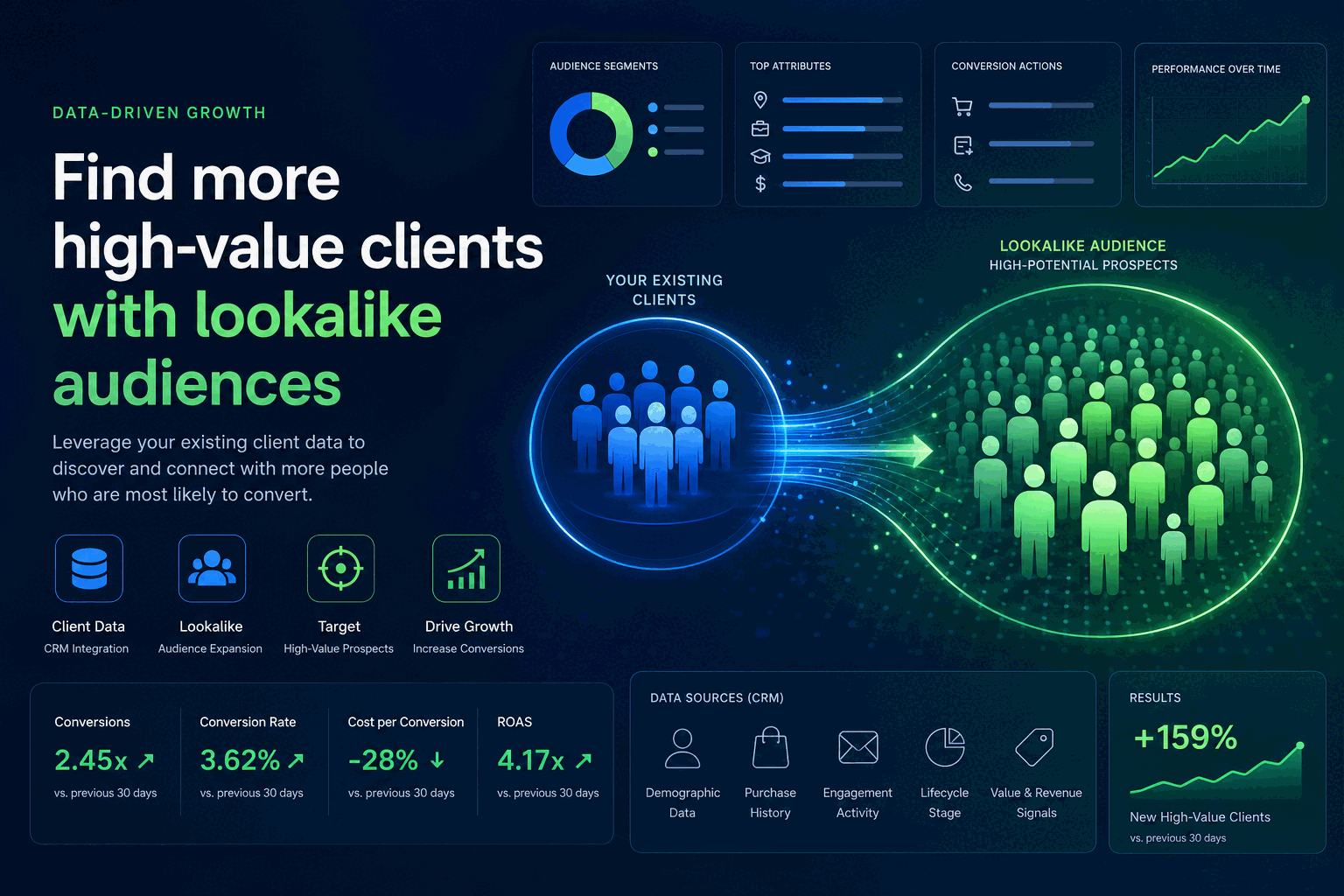
Lookalike audiences are groups of new prospects who resemble the people already taking valuable actions with your business. Instead of targeting only by broad interests or demographics, ad platforms use a “source audience” to find other people with similar traits, behaviors, and conversion patterns.
A source audience can include people such as:
- Current customers or clients
- Past purchasers
- Qualified leads
- Website visitors who completed a conversion
- Email subscribers
- App users
- People who engaged with your videos, social content, or lead forms
- High-value CRM contacts or closed-won opportunities
The ad platform analyzes patterns within that source audience, then builds a modeled audience of new people who are likely to share similar characteristics. For example, if your best clients tend to be operations managers at growing service businesses who engage with certain types of content and submit consultation forms, a lookalike model may help identify more people with similar behaviors and conversion potential.
This makes lookalike audiences especially useful for businesses that want better audience targeting without limiting campaigns to people who already know the brand.
Think of them as the middle ground between:
- Remarketing, which targets people who have already interacted with your business
- Broad prospecting, which gives the platform a large audience but less initial direction
- Interest targeting, which can be useful but may not reflect real buying behavior
- Lookalike targeting, which uses existing client or customer data to guide prospecting
For many advertisers, lookalike audiences are valuable because they help answer a practical question: “Who else looks like the people already buying from us?”
That makes them a strong fit for paid advertising strategy when your goal is not just more clicks, but more qualified leads, better conversion rates, and stronger return on ad spend.
Lookalike Audience vs. Custom Audience: What’s the Difference?
A custom audience is usually made from people you already know or people who have already taken an action. A lookalike audience is modeled from that audience to reach new people.
This distinction matters because many businesses confuse client data targeting, retargeting, customer lists, and lookalike audiences. They are connected, but they are not the same.
A custom audience might include:
- Uploaded customer or client lists
- Website visitors tracked through a pixel or tag
- People who submitted a lead form
- Past purchasers
- Video viewers
- Social media engagers
- CRM segments
- App users
- Offline converters, such as closed deals or in-store purchases
These are known people or known actions. You are either targeting them directly or using them as a source for modeling.
A lookalike audience uses that custom or source audience to find new people who resemble it. These new people may not know your brand yet, but the platform has identified signals suggesting they may be similar to your existing customers, leads, or converters.
| Audience type | Data source | Best use case | Example |
|---|---|---|---|
| Custom audience | Known customer list, CRM data, website activity, app activity, engagement data | Retargeting or creating a source audience | Uploading a list of past buyers |
| Retargeting audience | Website visits, product views, form starts, abandoned carts, video views | Re-engaging people who already interacted with your brand | Showing ads to people who visited your pricing page |
| Customer list audience | Uploaded emails, phone numbers, names, or other approved identifiers | Reaching known customers or creating lookalikes | Uploading closed-won clients from your CRM |
| Lookalike audience | Modeled from a source audience | Finding new prospects similar to your best customers or leads | Building a 1% lookalike from repeat buyers |
| Interest audience | Platform-defined interests, behaviors, or demographics | Testing broader prospecting themes | Targeting people interested in business software |
A simple way to remember it:
- Custom audiences are based on known people or actions.
- Lookalike audiences are based on modeled similarity.
- Retargeting usually focuses on people who already interacted with you.
- Lookalikes help expand beyond your existing audience.
Both can be useful. In fact, lookalike audiences usually work best when your custom audiences are well organized, high quality, and tied to meaningful business outcomes.
Why Client Data Makes Lookalike Audiences More Powerful
The quality of your source data has a direct impact on the quality of your lookalike audiences. If you give the platform a weak or mixed signal, it has less useful information to model from. If you give it a list of your best clients, strongest leads, or highest-value buyers, you are giving the algorithm a clearer picture of who matters most to your business.
That is why client data targeting can outperform generic interest targeting in many campaigns. Interest targeting often relies on assumed behavior. Client data is grounded in actual business relationships and conversion history.
Strong source audiences may include:
- Paying clients
- Repeat buyers
- High-lifetime-value customers
- Top-spending accounts
- Closed-won opportunities
- Qualified sales leads
- Customers who purchased a specific product or service
- People who completed high-intent website actions
- Contacts who moved beyond an initial inquiry into a serious sales conversation
Weak source audiences often include:
- Old email lists with inactive contacts
- Giveaway entrants
- Unqualified leads
- Newsletter subscribers with no buying intent
- Mixed lists of customers, vendors, job applicants, and cold contacts
- Contacts collected without clear consent
- People who engaged once but never showed meaningful intent
The goal is not simply to upload the biggest list possible. The goal is to provide the cleanest and most useful signal.
For example, a business could upload all 20,000 contacts in its CRM. But that list might include customers, cold leads, former employees, vendors, spam submissions, and outdated records. A smaller list of 2,000 closed-won customers or 500 high-value clients may produce a better model because it reflects real revenue potential.
Segmentation is where client data becomes especially powerful.
Useful ways to segment source audiences include:
- By value: top 10% of customers, high-lifetime-value accounts, premium buyers
- By purchase behavior: repeat buyers, recent purchasers, subscription customers
- By product or service: customers for a specific offer, category, or solution
- By lifecycle stage: qualified leads, opportunities, closed-won deals, renewals
- By intent: demo requests, consultation bookings, pricing page converters
- By sales quality: leads accepted by sales, leads that became opportunities, won deals
This helps the platform model toward the outcome you actually want. If your goal is to generate sales-ready leads, a lookalike based on qualified opportunities may be better than one based on general website traffic. If your goal is ecommerce revenue, a lookalike based on repeat purchasers may be stronger than one based on all visitors.
Privacy also matters. When using client data, businesses should be careful and compliant. That includes:
- Collecting data responsibly
- Having proper permission to use customer data for advertising
- Following platform policies
- Using approved upload methods
- Understanding how hashing works for customer lists
- Protecting data during storage and transfer
- Removing contacts who should not be included
- Keeping data current and accurate
Most major ad platforms use hashing when customer lists are uploaded. Hashing converts customer identifiers, such as emails or phone numbers, into coded values that can be matched against platform users without exposing the raw data in the same way. Even so, advertisers are responsible for making sure they have the right to use that data.
The better your data discipline, the better your audience strategy becomes.
How Lookalike Audiences Can Improve Return on Ad Spend
Lookalike audiences can improve return on ad spend by helping your campaigns focus on people who are more likely to behave like your existing customers or clients. Instead of spending the entire budget on broad reach, you give the platform a stronger starting point for finding qualified prospects.
Return on ad spend, or ROAS, is calculated as:
ROAS = revenue generated from ads ÷ ad spend
For example:
| Ad revenue | Ad spend | ROAS |
|---|---|---|
| $10,000 | $2,000 | 5.0 |
| $25,000 | $5,000 | 5.0 |
| $12,000 | $6,000 | 2.0 |
A 5.0 ROAS means the campaign generated $5 in revenue for every $1 spent on ads.
ROAS is often more useful than surface-level metrics such as impressions, reach, or clicks because it connects advertising activity to business results. A campaign can get thousands of clicks and still fail if those clicks do not turn into revenue. A smaller campaign with fewer clicks may be more valuable if it produces qualified leads or profitable sales.
Lookalike audiences can support better ROAS in several ways:
- Reduced wasted impressions: Ads are shown to people who more closely resemble valuable customers.
- Improved conversion potential: The audience is modeled from people who have already taken meaningful actions.
- Better prospecting efficiency: Campaigns can move beyond cold interest targeting.
- Stronger scaling opportunities: Businesses can reach new people without relying only on remarketing.
- More relevant creative testing: Ads can be tailored around the motivations of the source audience.
However, lookalike audiences do not guarantee profitability.
ROAS also depends on:
- Ad creative quality
- Offer strength
- Landing page relevance
- Conversion tracking accuracy
- Sales process and follow-up speed
- Budget and bidding strategy
- Product-market fit
- Competition and seasonality
- Average order value or customer lifetime value
For example, a strong lookalike audience may drive qualified traffic, but a slow landing page, weak offer, or confusing lead form can still hurt results. Likewise, if conversion tracking is incomplete, the platform may optimize around the wrong actions.
Lookalike audiences are not a shortcut around strategy. They are a tool that works best when the rest of the campaign is aligned.
How to Build Lookalike Audiences From Client Data
Building effective lookalike audiences starts before you open an ad platform. The most important work is deciding which client data represents the kind of customers, leads, or buyers you want more of.
1. Choose the Right Source Audience
Start with a source audience that reflects real business value.
Good source audience options include:
- Purchasers
- Repeat buyers
- Top-spending clients
- High-lifetime-value customers
- Closed-won deals
- Qualified leads
- Demo requests
- Consultation bookings
- Customers for a specific product or service
- Website converters with strong buying intent
Avoid building your first lookalike from a low-intent audience unless you are testing awareness campaigns. For example, a lookalike based on all website visitors may be too broad if most visitors never become leads. A lookalike based on people who submitted a sales form may give the platform a stronger signal.
Ask these questions before choosing the source:
- Does this audience represent the outcome we want more of?
- Is the data recent enough to reflect current buyers?
- Are these contacts high quality?
- Is the audience large enough for the platform to model from?
- Do we have permission to use this data for advertising?
If you sell multiple products or services, create separate source audiences when the buyers are meaningfully different. A company selling both entry-level subscriptions and enterprise contracts may not want to combine those customers into one source list.
2. Clean and Segment Your Client Data
Before uploading or connecting client data, clean it.
Remove:
- Duplicate contacts
- Bounced or invalid emails
- Outdated records
- Unqualified leads
- Internal employees
- Vendors and partners
- Job applicants
- Test submissions
- Spam form entries
- Contacts without proper consent
Then segment the list based on the campaign goal.
For lead generation, useful segments might include:
- Sales-qualified leads
- Opportunities created
- Closed-won deals
- High-value consultation requests
For ecommerce, useful segments might include:
- Repeat purchasers
- Recent buyers
- High-average-order-value customers
- Customers who purchased specific categories
For B2B campaigns, useful segments might include:
- Decision-makers from closed-won accounts
- Contacts from target industries
- Customers by company size
- Accounts with strong retention or expansion revenue
The cleaner the data, the clearer the signal.
3. Upload or Connect the Data Securely
Once your data is clean, you can upload or connect it through the advertising platform.
Common methods include:
- Uploading hashed customer lists
- Connecting a CRM integration
- Using website pixels or tags
- Creating audiences from conversion events
- Importing offline conversions
- Syncing app activity
- Building engagement-based audiences
For Meta and Facebook lookalike audiences, advertisers commonly begin with a source such as a customer list, website custom audience, app activity, or engagement audience. The platform then asks for details such as location and audience size percentage where available.
For Google Ads and similar platforms, modeled targeting may work through customer match, optimized targeting, audience expansion, or automated bidding signals depending on the campaign type and account eligibility.
At this stage, make sure you:
- Use approved data fields and upload formats
- Follow platform policies
- Confirm consent and privacy requirements
- Match source data to the right account
- Name audiences clearly
- Document what each audience contains
- Refresh lists on a regular schedule
A practical naming format can help keep campaigns organized:
Platform_SourceAudience_Segment_Date
Examples:
Meta_CustomerList_RepeatBuyers_Q1Google_CRM_ClosedWon_2026Meta_WebsiteConversions_ConsultationRequests_90Days
Good organization makes testing, reporting, and optimization much easier later.
Best Practices and Mistakes to Avoid With Lookalike Audiences
Lookalike audiences perform best when they are tested thoughtfully, refreshed regularly, and measured against real business outcomes. They should be part of a broader paid advertising strategy, not the only targeting method you rely on.
Use this checklist to improve performance:
- Test multiple source audiences, such as purchasers, qualified leads, and high-value clients.
- Compare narrow and broader lookalike ranges where the platform allows it.
- Start with tighter audiences, such as 1%, when quality matters more than scale.
- Test 2–5% or broader audiences when you need more reach.
- Exclude current customers when the goal is new customer acquisition.
- Exclude recent converters to avoid wasting budget.
- Refresh client lists regularly.
- Align creative with the source audience’s needs and motivations.
- Use conversion tracking to optimize toward meaningful actions.
- Compare performance against broad targeting, interest targeting, and retargeting.
Common mistakes include:
- Uploading every contact into one mixed list
- Using outdated CRM data
- Building lookalikes from low-intent audiences
- Targeting too broadly too soon
- Over-segmenting until audiences are too small
- Forgetting to exclude existing customers
- Judging performance before enough data is collected
- Measuring only clicks instead of leads, sales, or revenue
- Using the same creative for every audience
- Ignoring lead quality after the form submission
A useful testing structure might include:
| Test audience | Purpose | What to measure |
|---|---|---|
| 1% lookalike from customers | High-similarity prospecting | Cost per lead, conversion rate, ROAS |
| 2–5% lookalike from customers | Scale testing | Volume, efficiency, lead quality |
| Lookalike from qualified leads | Lead generation expansion | Cost per qualified lead |
| Interest audience | Benchmark comparison | Cost and conversion quality |
| Broad audience | Algorithmic benchmark | ROAS and acquisition cost |
| Retargeting audience | Demand capture | Conversion rate and revenue |
The key is to measure incremental value. A lookalike audience may generate leads, but you need to know whether those leads are better, cheaper, or more profitable than other acquisition audiences.
Privacy changes and platform automation have made first-party data more important, not less. Businesses that maintain clean customer records, track meaningful conversions, and build campaigns around actual client behavior are better positioned to get value from audience modeling.
Lookalike audiences are strongest when they are built from the right data, paired with the right message, and evaluated by the right metrics.
Should Your Business Use Lookalike Audiences?
Lookalike audiences can be a strong fit for businesses that already know who their best customers are and want to find more people like them. They are especially useful when your paid advertising strategy needs to move beyond broad interest targeting or guesswork.
That said, lookalike audiences are not a shortcut for weak data, poor tracking, or an unclear offer. They work best when they are built on reliable client data and supported by the rest of your marketing system.
If you are considering facebook lookalike audiences or similar audience targeting options on other ad platforms, use the following criteria to decide whether your business is ready.
Lookalike Audiences Are a Good Fit When You Have Quality Client Data
The strength of a lookalike audience depends heavily on the quality of the source audience. If you upload a list of your best customers, high-value clients, repeat buyers, or qualified leads, the ad platform has a better chance of finding people with similar characteristics.
Good source data may include:
- Customers who have purchased from you
- Clients with strong lifetime value
- Leads that became sales-qualified opportunities
- Email subscribers who later converted
- Website visitors who completed a valuable action
- Past buyers segmented by product, service, or revenue level
For example, a home services company may get better results from a list of completed jobs worth over a certain dollar amount than from a generic newsletter list. A B2B company may want to create a lookalike audience from closed-won clients instead of every contact who ever downloaded a guide.
The more closely your client data reflects the type of customer you want more of, the more useful your lookalike audience can be.
Lookalike Audiences Work Best With Clear Conversion Goals
Before using lookalike audiences, define what success looks like. Are you trying to generate booked consultations, product purchases, quote requests, trial signups, phone calls, or qualified form submissions?
Clear goals help you evaluate whether the audience is improving return on ad spend or simply creating more traffic.
Strong conversion goals are:
- Specific enough to measure
- Connected to revenue or pipeline value
- Tracked inside your ad platform or analytics tools
- Supported by a landing page designed for that action
- Reviewed regularly against cost and quality
If your goal is “get more exposure,” lookalike audiences may still increase reach, but it will be harder to prove business impact. If your goal is “generate sales calls with qualified prospects at a target cost per lead,” you can make better decisions about budget, creative, and audience quality.
You Need Enough Budget to Test Properly
Lookalike audiences need room to learn. If the budget is too small, the campaign may not generate enough impressions, clicks, or conversions to produce useful data.
You do not need an unlimited budget, but you do need enough to test:
- Different source audiences
- Audience sizes or similarity percentages
- Creative angles
- Offers
- Landing pages
- Retargeting follow-up
A common mistake is launching one lookalike audience with one ad and judging the entire strategy too quickly. Paid advertising requires controlled testing. One audience may underperform while another audience built from better customer data may produce stronger results.
If your budget only allows a few clicks per day, you may need to improve tracking, strengthen your offer, or focus on retargeting before investing heavily in lookalike expansion.
Your Offer and Sales Process Still Matter
Lookalike audiences can help you reach people who resemble your current customers, but they cannot fix an offer that lacks urgency, relevance, or trust.
Before scaling campaigns, ask:
- Is the offer clear within a few seconds?
- Does the ad match the landing page?
- Is the next step easy to understand?
- Does the page explain the value of taking action?
- Are there trust signals such as reviews, testimonials, case studies, or proof points?
- Does your team respond quickly to new leads?
- Are leads being followed up with consistently?
A well-built lookalike audience may generate more qualified traffic, but your landing page and sales process determine whether that traffic becomes revenue.
For example, if your ad offers a free consultation but the landing page is vague, slow, or difficult to use on mobile, performance may suffer. The problem may not be the audience. It may be the conversion experience.
When Lookalike Audiences May Be Less Effective
Lookalike audiences are not always the right first move. They may underperform if your foundation is not ready.
Common warning signs include:
- Poor or missing conversion tracking
- Very small customer lists
- Low-quality lead lists from outdated sources
- Lists that include unqualified contacts
- No clear way to connect leads to revenue
- Weak landing pages with low conversion rates
- Offers that do not match buyer intent
- Inconsistent sales follow-up
- Campaigns with too little budget to generate meaningful data
- No process for reviewing and improving performance
For instance, if your CRM contains years of mixed contacts, spam leads, vendors, job applicants, and unqualified prospects, uploading that entire list could confuse the platform. You may end up finding more people who look like low-quality leads instead of ideal buyers.
Likewise, if you cannot tell which leads became customers, it will be difficult to know whether your lookalike campaign is improving return on ad spend or simply increasing lead volume.
Readiness Checklist for Lookalike Audiences
Use this checklist to evaluate whether your business is ready to use lookalike audiences as part of your paid advertising strategy.
| Readiness Area | What to Check | Why It Matters |
|---|---|---|
| Data quality | You have clean client or customer data tied to real buyers | Better data creates stronger audience signals |
| Tracking | Conversions are tracked accurately across ads, forms, calls, and sales actions | You need reliable data to optimize campaigns |
| Budget | You can fund testing long enough to gather meaningful results | Small tests often need time before conclusions are useful |
| Offer | Your ad offer is clear, relevant, and valuable | Better offers improve conversion rates and lead quality |
| Landing page | The page is fast, focused, mobile-friendly, and aligned with the ad | Traffic must convert for campaigns to be profitable |
| Measurement | You can evaluate cost per lead, lead quality, revenue, and return on ad spend | Business results matter more than surface-level metrics |
If you can check most of these boxes, lookalike audiences may be worth testing. If several areas are weak, start by strengthening your foundation.
Lookalike Audiences Should Not Be Your Only Strategy
Lookalike audiences are most effective when they are part of a broader paid advertising system. They help you find new potential customers, but they should work alongside other campaign types and optimization efforts.
A stronger paid advertising strategy may include:
- Retargeting: Reaching people who visited your site, watched videos, opened lead forms, or engaged with your brand
- Creative testing: Comparing different messages, visuals, offers, and calls to action
- Landing page optimization: Improving page speed, clarity, trust, and conversion rates
- Conversion tracking: Measuring actions that matter to revenue, not just clicks
- Audience segmentation: Separating high-intent buyers, past customers, leads, and cold prospects
- Performance analysis: Reviewing cost, quality, pipeline value, and return on ad spend over time
Lookalike audiences can drive the top and middle of the funnel, while retargeting helps bring interested prospects back. Creative testing identifies which messages resonate. Landing page improvements increase the value of every click. Tracking and analysis show what is actually working.
Together, these elements create a more complete growth system.
When to Get Expert Support
If you are spending money on paid ads but are unsure which audiences are producing revenue, it may be time to get expert help. This is especially true if your campaigns are generating leads but your team is not confident in lead quality or return on ad spend.
Expert support can help with:
- Cleaning and segmenting client data
- Choosing the right source audiences
- Setting up facebook lookalike audiences correctly
- Building campaign structures for testing
- Improving ad creative and landing pages
- Installing or auditing conversion tracking
- Connecting ad performance to sales outcomes
- Identifying when to scale, pause, or refine campaigns
Lincoln & Lincoln Digital helps businesses build professional websites and digital marketing systems designed to drive real results. If your team wants to use client data targeting more effectively, lookalike audiences can be a valuable part of that strategy when they are built, tested, and measured correctly.
The key is not simply creating a lookalike audience. The key is using the right data, matching it with the right offer, and measuring performance against meaningful business outcomes.
FAQ
What is a lookalike audience?
A lookalike audience is an advertising audience made up of people who share similarities with an existing source audience. That source audience might be your customers, clients, email subscribers, website visitors, or qualified leads.
The ad platform analyzes patterns in the source audience and then finds new people who appear similar. The goal is to reach prospects who are more likely to be interested in your products or services.
Do lookalike audiences still work?
Yes, lookalike audiences can still work, but they are most effective when they are built from high-quality data and supported by strong tracking, creative, landing pages, and offers.
They are not a guaranteed fix for poor campaign performance. If your source data is weak or your conversion tracking is unreliable, results may be limited. When used correctly, they can still be a useful audience targeting tool within a broader paid advertising strategy.
How do you find or create look-alike audiences from client data?
To create look-alike audiences from client data, start by identifying a clean list of valuable customers or qualified leads. Then upload that list to your advertising platform as a source or custom audience. From there, create a lookalike audience based on that source.
A simple process looks like this:
- Export a clean customer or client list.
- Remove low-quality, outdated, or irrelevant contacts.
- Upload the list securely to the ad platform.
- Create a custom audience from the uploaded data.
- Build a lookalike audience from that custom audience.
- Launch campaigns and monitor performance.
- Refine based on lead quality, conversions, and revenue.
The better your source list, the more useful your lookalike audience is likely to be.
How effective are lookalike audiences for paid advertising?
Lookalike audiences can be very effective when they are based on strong client data and paired with a clear conversion strategy. They often help advertisers reach colder prospects who resemble existing buyers, which can improve campaign efficiency.
However, effectiveness depends on several factors, including data quality, audience size, ad creative, offer strength, landing page performance, conversion tracking, and budget. The best way to evaluate effectiveness is by measuring cost per qualified lead, customer acquisition cost, and return on ad spend.
What is the difference between a custom audience and a lookalike audience?
A custom audience is made up of people who already have a known connection to your business. This could include existing customers, email subscribers, website visitors, video viewers, or people who engaged with your social profiles.
A lookalike audience is made up of new people who resemble a custom audience or another source audience. In simple terms, custom audiences help you reach people you already know, while lookalike audiences help you find new people who are similar to them.
What data should you use to build facebook lookalike audiences?
The best data for facebook lookalike audiences is data tied to real business value. Good options include customer lists, high-value clients, repeat buyers, closed-won deals, qualified leads, or people who completed important conversion actions.
Avoid using broad, low-quality lists that include unqualified leads, old contacts, spam submissions, vendors, or people who are not likely to buy. For better results, segment your data around the type of customer you want more of, not just the largest list you have.